
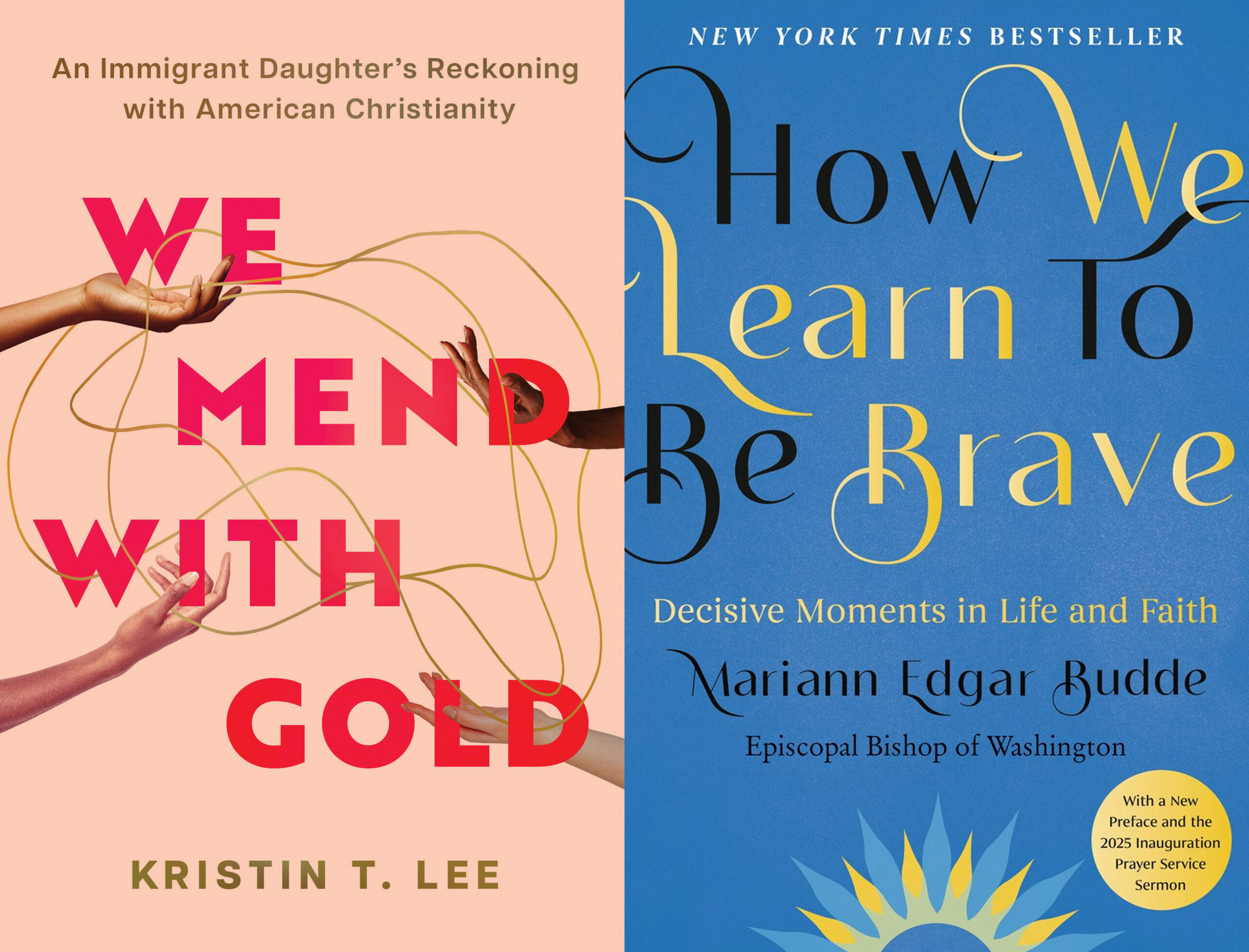
There are two books that are actively on my mind now.
This summer I started a book discussion group around the recently released (I think April 2026) We Mend With Gold by Kristin T. Lee. The subtitle of the book, An Immigrant Daughter’s Reckoning with American Christianity, says a lot. We’ve had one meeting about the book — the second one is next week — but already there’s so much in the book that I resonate with. In our first meeting I highlighted a line from her introduction. Kristin writes, “I want one fewer soul to feel crushed under the weight of religious fundamentalism.” In all my pastoral(ish) work as of late, I have acutely felt that same desire.
Whenever a conversation starts heading down a fundamentalistic road of us-verses-them, I sense it almost at a gut level and try to reverse course. It’s a pattern of Christianity I know too well. While it can lead one to feel vindicated/righteous/sheep-not-goat for a time, it is not the way of Jesus. It can ultimately crush us and lead us to be fearful and anxious in a world that God saw was good and very good. In many ways I’m still learning how to do this, especially in relation to churches (including my past ones) and systems that still uphold insular views. So much of Kristin’s journey is a mirror of my own. We considered many of the same questions regarding the faith of our upbringing and how it was enmeshed with culture. We had the same fears when we left familiar faith spaces thinking we’d be ostracized forever if we did not uphold certain dogmas. From what I can tell of the authors she quotes, we probably have similar bookshelves.
I wonder how she resonates with the blessing I shared at my last Sunday at my former congregation (“for the life you didn’t choose” from Kate Bowler’s The Lives We Actually Have). I revisit it quite often in my mind. The blessing ends like this:
God, show us a glimmer of possibility
in this new constraint,
that small truths will be given back to us.
We are held.
We are safe.
We are loved.
In many ways, “small truths will be given back to us” is happening. That the parts of faith that I have experienced to be most life-giving still persist. They have not gone away like many of the other doctrines I once held true. If I were to summon my inner bible quoting man, I would recount Paul’s infamous words in 1 Corinthians 13 still ring true: “And now faith, hope, and love remain, these three, and the greatest of these is love.” As I’m reading through the book, I’m finding ways that faith still resonates with me and I hope it also gives some healing to others as we are discussing the book together. I only wished we had more/longer sessions and read at a faster pace. I’ve had to put it down so I don’t get ahead of the group.
In the meantime, I’ve also picked up another book: How We Learn to Be Brave by Mariann Edgar Budde. I knew nothing of this priest-author until her sermon to Trump calling on him to have mercy on those who are affected by his administration’s policies. It’s been on my to-read list since early 2025. I finally picked it up last week because she recently released youth versions of the book so the book got nudged to the top of my list. I had no idea I would find this book so relatable.
The first few chapters speak about courage/bravery in leaving — but also in staying. And I’m finding so much of my previous ministry story in her reflections. She writes in her introduction, “The courage to be brave when it matters most requires a lifetime of small decisions that set us on a path of self-awareness, attentiveness, and willingness to risk failure for what we believe is right. It is also a profoundly spiritual experience, one in which we feel a part of something larger than ourselves and guided, somehow, by a larger Spirit at work in the world and in us.” I think back to the small “decisions” I made that put me on the path to parting with my fundamentalist upbringing. I did feel like I was losing everything. In hindsight I can see that I was shedding what was keeping me from growing in faith, hope, and love. I would have never voluntarily given it all up; at the time, it didn’t feel like a decision at all. It was another echo from the blessing I had previously quoted:
here you are,
forced into a story you never would have written
Since leaving I’ve been on the other side, not trying to do anything despite many who nudged me to start things. I guess to be fair, I start book clubs =D. Small things only. Budde writes, “I’ve had to learn, time and again, that faithfulness isn’t always about taking big leaps, but also walking with small steps, and that it’s possible to make a lasting difference in the world by tending to one small corner of it.” I’ve tried to do that; tend to this small corner. Be a good neighbor to my literal neighbors (yes, on my block). Be present and caring with people in my circle. In ministry I’ve tried to just do what’s naturally in my space; I’m not looking for anything. In doing so I’ve found people who still call me pastor despite me clarifying that I don’t formally pastor anybody. I’ve tried to limit myself, but I see God (or the fates, or fortune, or coincidence) expanding it bit by bit. Just this past week I had a conversation that was so pastoral in character. I found myself exercising mind and heart “muscles” that I’ve intentionally suppressed. I guess I’m still a pastor; small truths will be given back to us.
Not done with the book yet (either book), but I’m looking forward to what’s next. Not in a rush, nor with any certainty of purpose. Only with the confident assurance that we are held, we are safe, and we are loved in whatever comes next.