
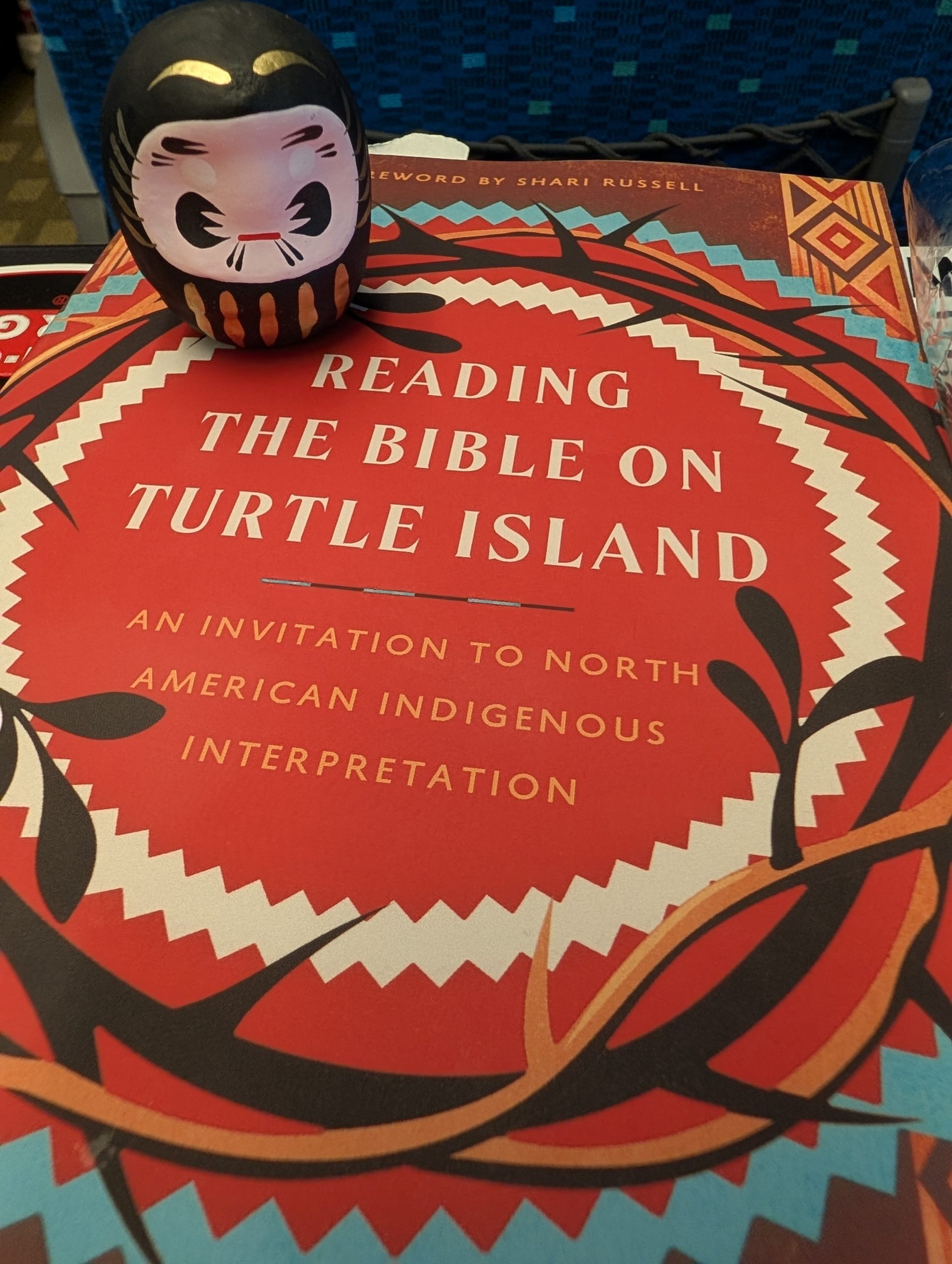
During our recent family trip to Japan, I started reading this as book, Reading the Bible on Turtle Island, mainly from just personal interest. The book describes ways that Indigenous communities on Turtle Island (North America) read and interpret the Bible in the context of their cultural traditions and practices: honoring their ancestors who came before them and recognizing the spirits in the natural world, living in harmony with one another and nature/spirits. I did not realize how much it would overlap with Japanese cultural expressions when I picked up the book.
One of the highlights inTurtle Island is how Indigenous communities recognized their relationship to nature, the land and all that the land sustains. Indigenous communities speak of how everything has a spirit; everything is personified. I had always understood it to mean that they thought there was a personal (not meaning “individual” but more of a being with agency) spirit inhabiting parts of the world. But as I thought more about this perspective on the world, I started to think how this leads a culture that cares for the world rather than treat it as a commodity to be used. Personifying the world leads one to give honor and respect to nature in the same way that one should see dignity in other human beings. In the Bible we find its authors calling its readers to pay attention to the mountains and the trees; to listen as they sing of Creator’s praise and glory. The same attention that indigenous cultures gave to the spirits — practices that earlier Christians condemned as primitive or pantheistic — actually align with the biblical witness. In the past I may have dismissed, or even condemned these perspectives, as a kind of syncretism, but my view and posture on these practices have changed.
As we visited different shrines and temples in Japan, I couldn’t help but wonder how these very visible reminders of spirits and ancestors, led Japanese society to see a much bigger reality than one that was devoid of the spirits. Small shrines outside Japanese homes or restaurants testified to this reality. Even the “mascots” that represented the transit system or the cherry blossoms or even buildings and parks… I wonder if somewhere in the creation/representation of these things there isn’t a foundation of respect/honor/gratitude; they’re not merely just cute illustrations but symbols that orient us, ever to subtly, to a fuller reality.
I wondered if this deeply ingrained “connectedness” in Japanese culture enables the politeness that foreigners often experience in our visits. I wonder if it is the foundation that enables an entire society to get behind having cleaner public spaces despite lacking trash cans in public spaces. Some of their cultural practices I could never imagine coming to the US because we’re too self-centered to be aware of public needs and goods (as a whole society).
I know there are darker (and brighter) sides to every society, but from my rose-colored glasses experience, Japanese public life, having such a small Christian population, looks more Jesus-like than more Christian-dominant societies. Perhaps the church seeking to “share the gospel” in Japan have more to learn from their embodiment of goodness in their culture.